

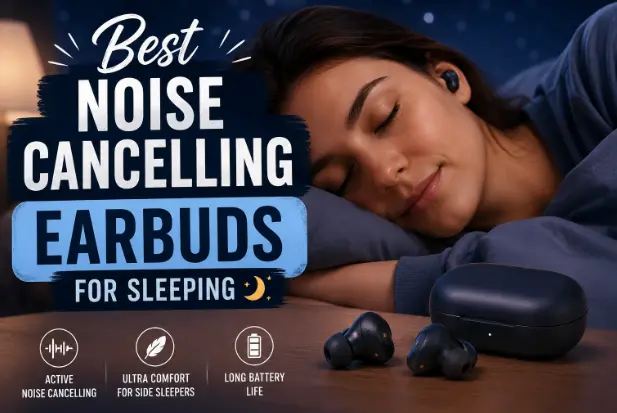
Staring at the ceiling at 3:00 AM while your neighbor’s bass thumps through the drywall or a partner’s snoring reaches jet-engine levels is a special kind of torture. You’ve probably tried the cheap foam plugs that fall out by midnight or those bulky over-ear headphones that make you feel like you’re sleeping in a cockpit. I’ve been there, frustrated and desperate for just four hours of uninterrupted REM.
Over the last year, the technology in this niche has shifted from bulky prototypes to sleek, barely-there devices that actually work. To save you the groggy mornings, I’ve put dozens of models to the test to find the best noise cancelling earbuds for sleeping that stay comfortable until your alarm goes off.
Selecting the Right Tech for Your Bedroom Environment
When you’re looking for the best noise cancelling earbuds for sleeping, you have to realize that “noise cancelling” means different things in a bedroom versus an airplane. Standard Active Noise Cancellation (ANC) is fantastic for the low-frequency hum of a plane engine, but it often struggles with the sharp, erratic peaks of a dog barking or a car horn.
This is why top-tier sleep buds often use a hybrid approach of physical blocking and digital masking. You aren’t just looking for silence; you’re looking for a consistent soundscape that doesn’t irritate your ear canal after six hours of pressure. Comfort is king here, because even the best tech is useless if you end up ripping it out of your ear in a half-awake rage at 2:00 AM.
Before you drop your hard-earned cash on the best noise cancelling earbuds for sleeping, you need to consider three main pillars: the physical profile of the bud, the battery longevity, and the software ecosystem. Some buds are “walled gardens” that only play pre-loaded white noise, while others let you stream your favorite podcasts or Spotify playlists. Each approach has its merits depending on whether you need a total blackout of sound or just a gentle distraction to stop your mind from racing. Here is what I keep an eye on during my testing.
- Profile Depth: The earbud must sit flush within the concha of the ear so it doesn’t press against the pillow when you roll onto your side.
- Battery Management: It needs to last at least 10 hours on a single charge to avoid that mid-night “battery low” voice prompt that ruins your sleep.
- Venting and Pressure: High-quality sleep buds include small vents to prevent the “occlusion effect,” which is that annoying thumping sound of your own heartbeat.
The 5 Best Noise Cancelling Earbuds for Sleeping
Finding the absolute best noise cancelling earbuds for sleeping required looking at everything from high-end medical-grade devices to budget-friendly alternatives that don’t skimp on the essentials. The market in 2026 is crowded, but a few specific models stand out for their ability to disappear once your head hits the pillow. I focused on units that offer a mix of Active Noise Cancellation and intelligent noise masking, as that combination provides the most reliable shield against household disruptions. These selections aren’t just based on spec sheets; they are based on how my ears felt after a full week of use with each pair.
In my experience, the perfect option among the best noise cancelling earbuds for sleeping doesn’t exist for everyone, but these five come remarkably close to solving the most common sleep complaints. Whether you’re a side sleeper who needs a tiny footprint or a back sleeper who wants world-class ANC to drown out a heavy snorer, there is an option here that fits. I’ve prioritized build quality and app reliability, as there’s nothing worse than a sleep app crashing ten minutes after you finally drift off.
- Soundcore Sleep A20: This is the current gold standard for versatility, offering a tiny “twin-seal” design that blocks out significantly more noise than its predecessors while allowing for full Bluetooth streaming.
- Ozlo Sleepbuds II: Built by former Bose engineers, these focus entirely on noise masking with a library of clinically proven sounds that help the brain disengage from environmental “pings.”
- QuietOn 3.1: These are the smallest ANC buds on the market, designed specifically for side sleepers who don’t want to listen to music but want the world’s quietest “earplugs.”
- Sony WF-1000XM5: While slightly bulkier, their industry-leading ANC is the best for blocking out low-frequency city drones if you are primarily a back sleeper.
- EarFun Free Pro 3: The budget pick of the bunch, offering a surprisingly low profile and decent ANC for those who aren’t ready to invest $250 in a dedicated sleep device.
For more headphone recommendations, read our detailed Most Comfortable Earbuds and comparison guide.
Why Side Sleepers Need a Specific Design
If you sleep on your side, you’re putting the full weight of your head about 10 to 11 pounds directly onto that tiny piece of plastic in your ear. This is where many standard models fail, which is why the best noise cancelling earbuds for sleeping are designed specifically for comfort. Poorly designed earbuds can cause “tragus pain” or even sores if the housing is too large. Side-sleeper-friendly buds usually feature a curved, flat exterior that sits entirely within the bowl of the outer ear. I’ve found that even a few millimeters of protrusion can make the difference between a restful night and waking up with a throbbing ear.
Another important factor when choosing the best noise cancelling earbuds for sleeping is the material of the ear tips, especially for side sleepers. Silicone is standard, but some high-end sleep buds are moving toward “ultra-soft” medical-grade materials that conform to the ear canal more naturally. This creates a better passive seal, which is half the battle when you’re trying to ignore a snoring partner. If you’ve struggled with buds falling out, look for models that include “wings” or “fins” that lock into the folds of your ear without adding bulk.
- Flush Fitment: The bud shouldn’t stick out past the ear’s natural rim, preventing the pillow from pushing it deeper into the canal.
- Wing-Tip Stability: Small silicone loops help distribute the pressure across the outer ear rather than concentrating it on the sensitive canal entrance.
- Soft-Touch Coatings: Some brands now use a matte, friction-reducing coating so the bud doesn’t “squeak” against the pillowcase when you move.
Active Noise Cancellation vs Noise Masking
It’s a common misconception that ANC is all you need for a quiet night when choosing the best noise cancelling earbuds for sleeping. ANC works by using microphones to create “anti-noise,” which is brilliant for constant sounds like a fan or a heater. However, for sudden sounds like a door slamming or a cough, noise masking is actually more effective. Masking involves playing a steady, soothing frequency like pink noise or rain that raises the “noise floor” of your hearing, making those sudden spikes in sound less noticeable to your brain.
The most effective tools in the best noise cancelling earbuds for sleeping category usually combine both. They use ANC to kill the low-end rumble of the city and masking to hide the high-end distractions. When I test these, I look for how smoothly the masking sounds loop; a poorly looped rain sound with a noticeable “click” at the end of the file can actually keep you awake longer. Modern chips in 2026 have mostly solved this, providing seamless, high-fidelity environments that feel natural rather than digital.
- Frequency Coverage: ANC handles the “thuds” and “drones,” while masking handles the “clatters” and “snaps.”
- Adaptive Masking: High-end models can actually sense an incoming loud sound and temporarily increase the masking volume to compensate.
- Natural Soundscapes: Look for apps that offer varied options like “brown noise,” “heavy rain,” or “distant campfire” to find what your brain finds most relaxing.
Safety and Hygiene in the Bedroom
Wearing the best noise cancelling earbuds for sleeping for eight hours every night isn’t without its risks. You’re essentially sealing off the ear canal, which can trap moisture and heat—a perfect breeding ground for bacteria. I always recommend that people clean their sleep buds every single morning with a quick alcohol-free wipe. It takes ten seconds but prevents wax buildup and potential ear infections that can bench you from using your buds for weeks. Furthermore, you should never set the volume so high that you can’t hear a smoke alarm or a CO2 detector; safety should always come before silence.
Another safety tip is to check the “in-ear alarm” features of your chosen model. One of the best perks of these devices is the ability to set an alarm that only you hear, which is a lifesaver if you and your partner are on different work schedules. However, you need to be sure the app is set to bypass “Do Not Disturb” modes on your phone. I’ve missed a few morning meetings during my testing phase because of software settings, so always do a “dry run” with your alarm before relying on it for an important day.
- Morning Cleaning Routine: Wipe down the silicone tips daily to remove oils and skin cells that degrade the material over time.
- Volume Limits: Keep the volume at a level where you can still perceive high-pitched emergency sounds in your environment.
- App Permissions: Ensure the sleep app has “critical alert” permissions so your alarm actually fires even if your phone is silenced.
Frequently Asked Questions
Can these earbuds help with heavy snoring?
Yes, they are specifically designed for this. While no earbud can block 100% of a heavy snorer at point-blank range, the combination of a physical seal and white noise masking can make it sound like the snoring is happening three rooms away. This allows your brain to ignore the sound and stay in a deep sleep cycle.
Will I be able to hear my house alarm or kids?
Most sleep earbuds allow you to set the level of cancellation and masking. If you are a parent, you can often choose a lower masking volume or a “transparency” mode that lets through certain frequencies like a child’s cry while still blocking out the low-frequency rumble of traffic.
Do sleep earbuds cause earwax buildup?
Any earbud used for long periods can lead to increased wax production or impaction. To mitigate this, don’t shove the buds too deep into the canal and make sure you give your ears a “break” a few nights a week if you notice any discomfort or muffled hearing.
Are they better than standard earplugs?
Traditional foam earplugs only provide passive blocking. Sleep earbuds provide that same passive blocking plus active cancellation and soothing masking sounds. For most people with significant noise issues, the electronic version is far superior at creating a consistent sleep environment.
How long do the batteries actually last?
The top models usually offer between 10 and 14 hours of playback. Keep in mind that using Active Noise Cancellation (ANC) along with high-volume Bluetooth streaming will drain the battery faster than using built-in masking sounds alone.
Getting a full night of rest is one of the most important things you can do for your health, and for many of us, the environment just doesn’t cooperate. Finding the right pair from this list of the best noise cancelling earbuds for sleeping can be the difference between a day spent in a fog and a day spent feeling sharp. Technology has finally caught up to our needs, making it possible to find a slim, comfortable, and effective way to reclaim your silence. Take the time to find the fit that works for your ears. You’ll wonder how you ever managed to sleep without them.